


40 Years Ago: The Right Stuff


40 years ago today, The Right Stuff (1983), Philip Kaufman’s quicksilver adaptation of Tom Wolfe’s book about the American space program, premiered (appropriately) at the Kennedy Center.
The date finds us in the midst of related anniversaries — 60 years since the end of the Mercury Program, 50 years since the end of the Apollo Program. And (while everything else in the news is unbelievably awful) those anniversaries arrive at a time when space exploration has been revitalized. In case you don’t follow such things, there have been recent announcements about a plan to return to the moon, a manned mission to Mars, the recent deployment of the Webb telescope (vastly more powerful than the already history-making Hubble), and the many recent triumphs in private space exploration by companies like SpaceX, which accomplished the world’s first vertical propulsive rocket landing. (Give the devil his due. Speaking of Satan, there’s also the 2020 creation of the U.S. Space Force, which had the bad fortune to be greenlit during the Trump Administration and has thus erroneously been associated with 45. Trump’s taking credit notwithstanding, the Space Force had actually been in the works since the time of Eisenhower, thus the Congressional approval which never would occurred for some momentary whim. It’s not a Trump accomplishment in any way, shape, or form).
Shouldn’t we be concentrating on things like world peace and ending hunger, a lot of people wonder? Well, I’m pretty sure that astrophysicists and aeronautical engineers weren’t going to be working on those problems anyway. I’m for the human race progressing in every positive direction it’s capable of. And yes it’s an an expensive way to fire the public’s imagination, but the discoveries made by these complex endeavors always do end up benefitting humanity in some way. Of course, after many years (decades really) of languishing, the space program is on a front burner again due to competition. India just landed a vehicle on the moon. China poses a much greater threat. And of course, there’s still the Russians.
The original Space Race with Russia during the Cold War is the freeze-dried meat and drink of The Right Stuff. It’s an interesting mix of Reagan-era patriotism and nostalgia and Kaufman’s hippie-dippie deconstruction of the machinery of government propaganda. The tonal complexity may be one reason why the film lost money at the box office, a surprising fact I only just learned. For my friends and I watched this movie together at least a dozen times, twice in cinemas, then on television and home video. We quoted its lines (“Let’s light this candle”; “No Bucks, No Buck Rogers”, “Spam in a can”, “[He] screwed the pooch”, “Ya got any Beemans?”). We went back and read Wolfe’s book, which is different from the film in lots of ways. Three of us even took turns going around in a Chuck Yeager style leather bomber jacket, literally emulating the film’s style just as young men used to apeJames Deanand Marlon Brando.
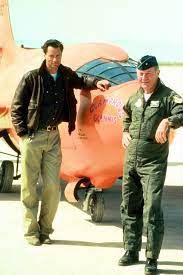
Interestingly, it never occurred to any of us to actually go into the military. We were showfolk; we liked FANTASIZING about being pilots, and mimicking pilot culture. And because we were liberal young guys (we would have been 18 when the movie came out, but we kept this up easily through our early 20s), the Reagan era Top Gun fantasy was not ours. (In fact I’ve never been able to stomach that movie, and have no interest in seeing the sequel). Breaking the sound barrier? YES. First American to orbit the earth? YES. And (though the film disappointingly doesn’t go there) first man on the moon? Also YES. Physical courage in the service of exploration (and yes, testing your own limits) appealed to us. Having been kids during the Vietnam era, dropping bombs and getting in firefights was less interesting.
We were also born after the Mercury era was over, so living vicariously through those earlier times was exhilarating to us. Kennedy’s Space Program had inspired everyone, from the creators of Coney Island’s Astroland…to Doris Wishman (Nude on the Moon). By contrast, our own stretch of the Space Age was riddled with disappointment. I was eight or nine years when the Apollo program was cancelled. CANCELLED! Due to “public disinterest”? And “other budget priorities”, so they claimed, but as we all know, the government has no problem spending the people’s money when they have a will to do so. I swear the end of lunar exploration was a sort of minor trauma for me. It signaled an end to human progress. It meant the death of whatever hopes we harbored that the future would look The Jetsons or Star Trek. And NASA’s next projects…Skylab and the shuttle program and the international space station were not calculated to restore optimism. The point was to GO places, OTHER PLACES, not hover around the earth and be tethered to it, or zip back and forth on routine runs like garbage men. Our leaders seemed to decide that the future would not be better, but more of the same.
Of course, The Right Stuff was pretty clear that the original motives for space exploration were not pure either. It was about beating the Russians in international prestige, and not being vulnerable to them if they decided to militarize space. So it comes back to Top Gun anyway. But the movie does a good job of unhitching the flyboys from the politicians and bureaucrats. Taking a cue from Wolfe’s book, they’re just kind of like big kids, who love to go really, really fast in their flying hot rods.

The cast was like an orgy of real life show business heroes. Levon Helm of The Band was the narrator and pilot Jack Ridley; Sam Shepard as Chuck Yeager, the unsung test pilot who broke the sound barrier in the X-1 in 1947 (Yeager himself has a cameo in the film); Ed Harris has the plum role of John Glenn, first American to orbit the earth and at the time a powerful U.S. Senator (he thrilled us all years later when he returned to space at the age of 77); Fred Ward as the doubly ill-fated Gus Grissom; Dennis Quaid as Gordo Cooper; Scott Glenn as the Jose Jimenez-loving Alan Shepard,Lance Henriksen as “Wally” Schirra, Scott Paulin as Deke Slayton, Charles Frank as Scott Carpenter, Scott Wilson as Scott Crossfield.

Like the space program itself, the producers seem to have put everything including the kitchen sink into this epic. Though this is really is a “guy’s movie” (at the time there were no female air force pilots or astronauts) there was an effort of sorts to involve women, and the females in the cast make for a list about as legendary as all those male stars: Barbara Hershey, Veronica Cartwright (fresh off of Alien), Pamela Reed, Mary Jo Deschanel (mother of Emily and Zooey), and Kathy Baker, among others. Their characters, there just to encourage or whine about their husbands, are less than ideal. For comic relief there’s Donald Moffat as Lyndon Johnson, and Jeff Goldblum and Harry Shearer in a kind of Mutt and Jeff style comedy team, as astronaut scouts. And there some real old time show biz veterans in the cast. Broadway giant Kim Stanley plays Pancho the sassy desert barmaid; John Dehner plays millionaire Henry Luce (I knew his son Henry Luce III in my N-YHS days); familiar bit player Royal Dano plays that spooky minister. David Clennon is memorable as a press flack. A lady named Peggy Davis performs a fan dance as Sally Rand (interestingly, back in the day, there was another Peggy Davis who danced in the Ziegfeld Follies, but she died in 1931).
Critics rightly loved and love The Right Stuff, and it’s just astounding to me that it didn’t click with the public. The big movie the month it was released was Never Say Never Again, which marked the return of Sean Connery as James Bond. It’s a fantasy about stolen nuclear missiles and the glamorous government spy who recovers them. People live and die by their illusions, seems to be the lesson.

Comments