


200 Years Ago Today: The Birth of Castle Garden


A few days ago I led a 13 mile walking tour tracing the origins of New York theatre to its peak in the 20th century. I began that tour at Castle Clinton National Monument in the Battery, not because it was the birthplace of American theatre (it’s not), but for reasons of geography (it’s at the bottom of Manhattan) and to celebrate the upcoming bicentennial of the building’s beginning as an entertainment venue, which is today.

The structure dates prior to 1824, however. It had originally been built in the run-up to the War of 1812, as a literal military fort for the protection of Manhattan. New York had been occupied by the British during the Revolution and it had been a miserable experience, never to be repeated. The “Castle” or fort, was named after DeWitt Clinton, NYC Mayor, New York State Governor, and James Madison’s rival in the 1812 Presidential Election. As the lead booster of the Erie Canal, Clinton was also largely responsible for NYC becoming America’s largest city, overtaking rivals like Philadelphia and Boston. His uncle, George Clinton, was Vice President under both Madison and his predecessor Thomas Jefferson. (Bill Clinton, whose real last name is Blythe, is unrelated). The fort was originally located on an island, accessed by a footbridge.
Castle Clinton was decommissioned in 1823, and turned into a pleasure garden. A second story was added, with walkways offering views of the harbor. A fountain was installed, and botanical plantings, as well as a theatre, a ballroom, and a restaurant. Like many pleasure gardens, it offered entertainments like musical concerts and balloon ascensions. At its height, the opera house at its center could seat 6,000 patrons:
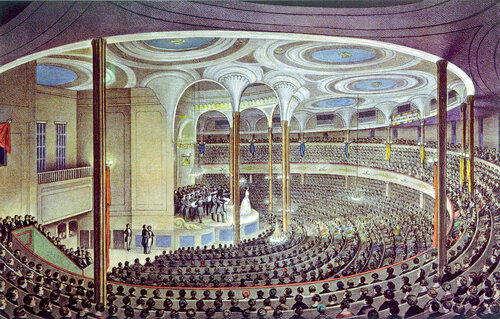
Castle Garden is where P.T. Barnum legitimized both himself and popular entertainment in general by presenting the “Swedish Nightingale” Jenny Lind to sold out houses in 1850. The following year saw performances by a star of equal magnitude, the notorious dancer Lola Montez! Those two performers were the poles of female public image in that day, Seraph and Succubus within a twelvemonth period. Castle Garden ceased to be an entertainment venue shortly thereafter, not through any deficiency of these two top-drawing performers, but because the city center was shifting ever northward. By now there were numerous other venues farther uptown, such as Niblo’s Garden and the Academy of Music.
But Castle Garden a.k.a. Castle Clinton enjoyed many lives after this.
From 1855 through 1890 it was New York’s immigration center. Previous to this, immigrants landed wherever their ships docked. Now it was centralized, making processing more efficient, a necessity during the first wave of major immigration. By the the time of the second wave, the immigration center was moved to Ellis Island. The landfill that now connects Castle Clinton to Manhattan Island was added in 1855.
From 1891 to 1941 Castle Clinton was home to the New York Aquarium. How lucky those New Yorkers were to have it right in Manhattan! We have Robert Moses to thank (and curse) for the fact that the Aquarium closed. He intended to build a bridge to Brooklyn that would cut through lower Manhattan. The entire world fought him on it (resulting in an alternate plan, the Brooklyn-Battery Tunnel), but meanwhile the Aquarium had been shuttered. It reopened in Coney Island in 1957, which is why I said that in addition to cursing him, we (at least we who love Coney Island) can thank him (for that anyway).
Meanwhile, Castle Clinton became a national monument in 1946. It and the surrounding Battery Park became public resorts, and have been periodically restored, renovated, and improved many times since, usually about once a decade. Most tourists know it as the departure point for the better known destinations of Ellis Island and the Statue of Liberty, but those in the know regard Castle Clinton as an attraction in its own right. Indeed, all lovers of American entertainment should make a pilgrimage.
For more on show business history please check out No Applause, Just Throw Money: The Book That Made Vaudeville Famous.

Comments