


18 Barbecue World Heritage Sites UNESCO Recognition

It’s time that barbecue received the international recognition it deserves, and there actually is a vehicle tailor-made for that: UNESCO. That’s the United Nations’ Educational, Scientific and Cultural Organization, and it promotes the preservation of both tangible and intangible cultural heritage, or that’s what it’s supposed to do. Tangible sites include some in the United States, such as buildings (Independence Hall) and natural wonders (the Grand Canyon). Fine.
UNESCO also is supposed to honor Intangible Heritage, and it’s jumped on such obvious wonders as the artisanal skill and culture of the French baguette, the Neapolitan pizza, and Kimchi, as well as less obvious artisanal skills and cultures, such as the Kupres grass mowing competition in Kupres and picking iva grass on Ozren mountain. (I grant that these may be obvious only to residents of Bosnia-Herzegovina.) Also fine.
UNESCO has not recognized a single cultural heritage tradition from the United States. Not one. Not fine.
Well, UNESCO sits in Paris, and rumor has it that some folks in Paris scorn American culture. Honestly now, mes amis! Jazz, the blues, and bluegrass aren’t longstanding traditions of undoubted worth? Heck, the traditional hog call is right up there with Alheda’a camel call. Think of our many distinctive foods that are the product of artisanal skill handed down through generations. Standing magisterially above all other traditions is barbecue.
The United States is a huge and diverse nation, and barbecue involves food traditions as various and distinct as the grasses of Bosnia-Herzegovina. The oldest and, in my opinion, the greatest is that of pork. Pork barbecue dates back to the colonial period, and has played a key role in the culture of the nation, from community-building to vote-buying, the latter often in tandem with another American cultural wonder, Kentucky bourbon.
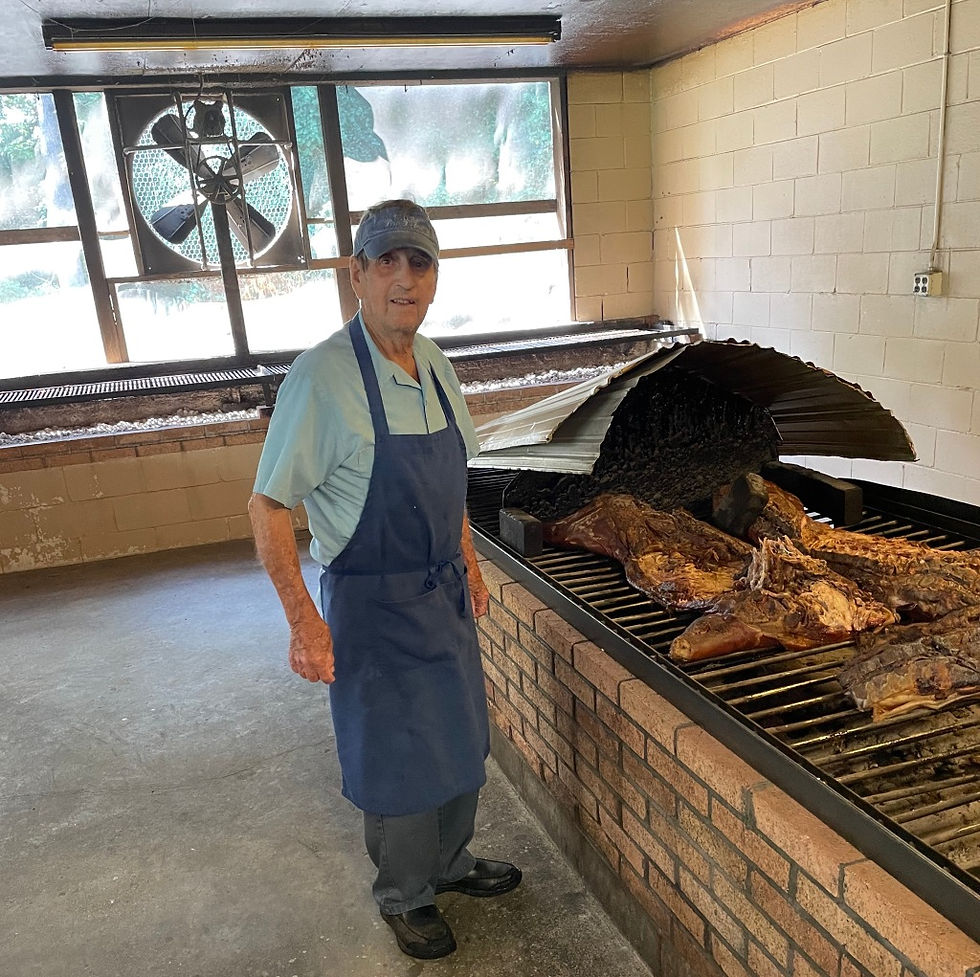
For centuries Americans have cooked pork slowly directly over wood coals, and served barbecue with a wide range of distinctive sauces and side dishes. The core elements of pork barbecue (beef has very different traditions) are (1) pork (2) cooked directly over (3) wood burned down to coals, with (4) a human being watching over it.

As one barbecue legend, maybe it was Pete Jones or Jess Swisegood, declared that
If pork fat ain’t dripping down on the coals, it ain’t barbecue.
Places true to this core tradition are disappearing, as many (or most) “barbecue” places now cook entirely or in part with gas or electricity, often with the cooking regulated by machines rather than artisans. The tradition, the culture, is at risk. It’s time we stepped up to recognize the value of our culture, and demand UNESCO recognition. To that end, here’s a very partial list of places that I personally have verified adhere tightly to the core tradition. That means that I’ve eaten there and personally seen the pit in recent years. Thus many very worthy places, including some of my very favorite places (Stephenson’s, Bar-B-Cue King, Payne’s, the Dixie Pig … and so many more), are not on this list.
Alabama

North Carolina
South Carolina
Tennessee

Virginia
Don’t get angry. My travels have been limited travels, and often I haven’t seen the cooking. I acknowledge the large number of great barbecue places in Arkansas, Georgia, and Kentucky, and applaud the resurgence of wood-cooking barbecue in Virginia, and the hopeful signs of direct heat cooking at places like Two Drummers. This is the beginning of a conversation that I hope will blossom and expand.
Again, other meats have their own traditions, and these deserve their own recognition. Think of the Texas traditions exemplified by the City Market in Luling and Vera’s Backyard Bar-B-Que in Brownsville, to name two. And my apologies to those worthy places that I left out. I welcome that verification of additional sites, as I intend to supplement the list, state by state, and to add the Texas and other noble barbecue traditions. I eagerly welcome your thoughts on various barbecue traditions, about some of which I’m unaware, no doubt.
So what do we do? The UNESCO procedure for designating a cuisine is as opaque and jargon-ridden as you can imagine. To start, spread the word. Search out local direct heat pits and let me know. A Texas specialist needs to come forward. Most of all, share this with your state and local elected officials, and with your senators and representative. It might keep them busy enough to avoid actual harm.
***
And while you’re at it, click “follow” on our front page to receive blog posts in your email box. Or bookmark us and check in from time to time. If you’re planning a trip, you can “Search” the name of the destination city, state, or country for good restaurants (in Europe, often close to sites, like the Louvre or the Van Gogh Museum, that you’ll want to visit in any event). Comments, questions, and suggestions of places to eat or stories to cover are very welcome. And check out our Instagram and Twitter pages, johntannerbbq.

Comments